Poverty Rebels: Black and Brown Protest in Post-Civil Rights America


Poverty Rebels: Black and Brown Protest in Post-Civil Rights America
Poverty Rebels: Black and Brown Protest in Post-Civil Rights America
Member Benefits
 30% Off All Books - Savings that support storytellers, not stock prices.
 Fight Book Bans - Book profits fund the Rainbow Book Bus, getting banned books to LGBTQ+ youth.


Member Book Price
$165.00
$115.50
Couldn't load pickup availability
Description
Description
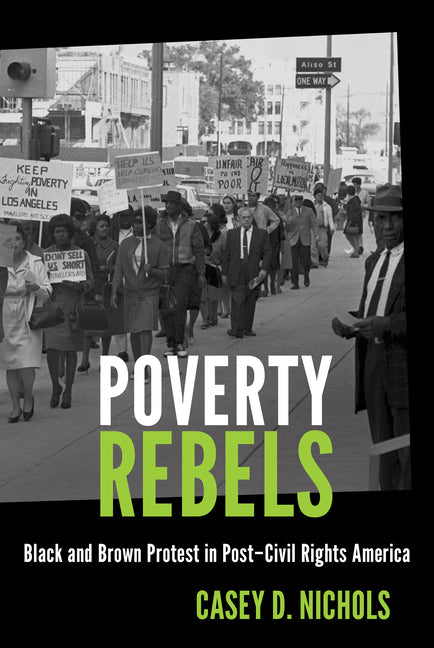
In 1960s Los Angeles, a powerful network within Black and Chicana/o organizations transformed the War on Poverty and Model Cities program. Black and Brown activists worked together and separately to use the US federal government's War on Poverty as an opportunity to establish programs that would counteract the neglect that led to underfunded schools, inadequate housing, and a lack of community institutions. Casey Nichols examines this diverse group of intentional and unintentional collaborators she calls "poverty rebels," which included politicians, activists, youth, professionals, community members, and local people.
Poverty rebels leveraged federal antipoverty funding to work around the limited capacity of the Civil Rights Act of 1964 to address the dual impact of race and class in African American and Mexican American communities. They understood that unequal policy had created their urban realities and sought to redefine antipoverty legislation in a way that improved their material lives. Drawing on a wide range of sources, including local and federal government documents, oral histories, and organizational records, Nichols examines vital links between the nation's social and political spheres. Ultimately, she argues that Black-Brown relations gained greater national significance during the mid-1960s amid important civil rights victories and social policies to address so-called disadvantaged communities. By coming into social and political proximity, African Americans and Mexican Americans constructed a national dialogue about Black-Brown relations that had shared benefits, and that continues to shape policy debates today.
Poverty rebels leveraged federal antipoverty funding to work around the limited capacity of the Civil Rights Act of 1964 to address the dual impact of race and class in African American and Mexican American communities. They understood that unequal policy had created their urban realities and sought to redefine antipoverty legislation in a way that improved their material lives. Drawing on a wide range of sources, including local and federal government documents, oral histories, and organizational records, Nichols examines vital links between the nation's social and political spheres. Ultimately, she argues that Black-Brown relations gained greater national significance during the mid-1960s amid important civil rights victories and social policies to address so-called disadvantaged communities. By coming into social and political proximity, African Americans and Mexican Americans constructed a national dialogue about Black-Brown relations that had shared benefits, and that continues to shape policy debates today.
About the Author
About the Author
Casey D. Nichols is assistant professor of history at Texas State University.
Critical Reviews
Critical Reviews
"Poverty Rebels opens up a critical space for discussing how social class can serve as an important shared identity that can help bridge race/ethnic differences."--Society for US Intellectual History
Publishing Information
Publishing Information
Publisher:
University of North Carolina Press
Pub date:
2025-03-25
Length:
216 pages

The Allstora Membership
Membership Perks:
- Save 30% on all online store purchases
- Exclusive access to author's content
- You pay less, but authors still earn double
Membership Terms:
First Month:
$0.00
Monthly price:
$5.00
- To access membership discount simply log in and add to cart, discount applied automatically.
- One month free trial, cancel anytime. Membership renews on the 15th of each month.