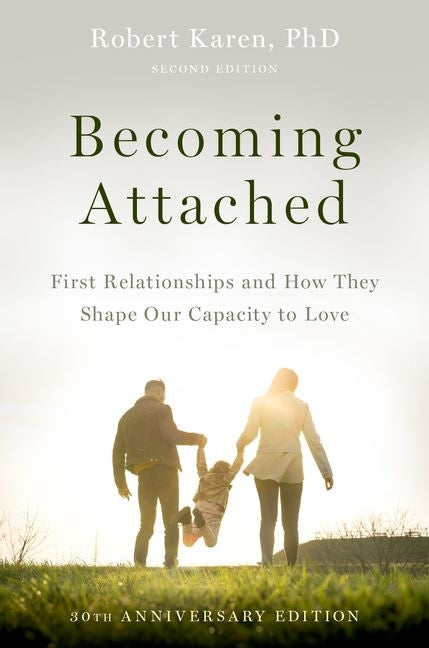
Becoming Attached: First Relationships and How They Shape Our Capacity to Love


Becoming Attached: First Relationships and How They Shape Our Capacity to Love
Becoming Attached: First Relationships and How They Shape Our Capacity to Love
Member Benefits
 30% Off All Books - Savings that support storytellers, not stock prices.
 Fight Book Bans - Book profits fund the Rainbow Book Bus, getting banned books to LGBTQ+ youth.


Member Book Price
$47.82
$33.48
Couldn't load pickup availability
Description
Description
The tumultuous history of the attachment idea---and the pioneers who fought for it. Now in a fully expanded and updated 30th anniversary edition. Robert Karen's Becoming Attached tells the story of one of the great undertakings of modern psychology: the hundred-year quest to understand what children need and what constitutes good-enough parenting. A century ago, most childcare experts were clueless about love and its role in child development. Behaviorists warned against spoiling children with too much affection ("Never hug and kiss them, never let them sit in your lap"), while geneticists argued that parental love is irrelevant because genes alone determine who we are. Into this confusion stepped John Bowlby, the headstrong British psychoanalyst whose decades-long partnership with American psychologist Mary Ainsworth would revolutionize child development and childcare. In recent decades attachment research has exploded worldwide, as evidence for the benefits of secure attachment grow. Numerous studies attest to attachment's critical role in emotion regulation, self-confidence, sensitivity, empathy, the capacity to forgive, and much else. Crucial questions about child rearing can now be answered. Are babies able to handle separations from the mother? What are the risks of daycare for children under one, and what can parents do to manage those risks? How essential is the sensitivity, reliability, self-awareness, and joyfulness of parental love? And how does the nature of parental love change as the child grows older? What do live fMRI studies reveal about the neural patterns of the loving parent, which also appear in the adoring infant and in adult romance? What have we learned about parental psychology, good and bad, and how it works its way into the child? How important is the perfectly (or poorly) synchronized play between parent and baby, invisible until the advent of slow-motion video? Karen tells a dramatic story of scientists at work and at war, what happens to research when politics and gender roles get involved, and how the nature-nurture debate shifts with the discovery that childhood experience can alter the expression of genes? Karen shares personal anecdotes drawn from the lives of leading attachment researchers, from his patients, and from his own experience to illuminate attachment themes. He argues that we all have elements of security and insecurity in our psyches, with the insecure self readily activated in intimate relationships. He writes: "When conflicts arise, the insecure self threatens to commandeer our being, leading us, as though through quicksand, into a repetition of old patterns." And, yet, Karen contends, attachment status can change, and what he calls "seeking one's secure self" is an essential quest of mature adulthood. For many readers Becoming Attached will be not just a voyage of discovery in child development and its pertinence to adult life, but a voyage of personal discovery as well; for it is almost impossible to read this material without reflecting on one's own life as a child, a parent, and an intimate partner in love or marriage.
About the Author
About the Author
Robert Karen is Assistant Clinical Professor at the Derner Institute of Advanced Psychological Studies, Adelphi University; Adjunct Clinical Faculty, Postgraduate Training Program in Group Psychotherapy, Adelphi University.
Critical Reviews
Critical Reviews
"A stunning portrait of one of the most significant bodies of work in the modern era: the quest to establish that each of us comes into the world with both the need and the readiness to be loved and cherished. What emerges is a brilliant book, eloquent and deeply thoughtful. The last chapter left me weeping." -- Arietta Slade, PhD, Professor of Clinical Child Psychology, Yale Child Study Center"This new edition of Becoming Attached is super. Karen manages to thoroughly capture the history of this sprawling field, including the critical changes in our thinking about parents and children that have taken place in the last three decades. The scholarship is remarkable, and the writing is wonderful. A riveting and completely impressive piece of work." -- L. Alan Sroufe, PhD, Professor Emeritus, Institute of Child Development, University of Minnesota"Beautifully written and thoroughly captivating. Karen has done a wonderful job of presenting the essence not only of attachment theory, but also of the lives and struggles of the theorists, researchers, and clinicians-and their critics-who have played such an important role in the development of one of the century's most compelling and important developmental theories." -- Robert B. Stewart Jr, PhD, Journal of Clinical Child Psychology"This is the best book about psychology that I have ever read --- and I am a psychologist with over 45 years of clinical experience. Karen does a remarkable job of integrating research findings with psychoanalytic theory and clinical stories (including some from his life). He also tells some interesting stories about the key figures in the evolution of this field of knowledge. I have recommended this book to my clients and my colleagues. If I were to write a book, this is the one I would like to write." -- Mark E. Owens, PhD, Amazon Reader
Publishing Information
Publishing Information
Publisher:
Oxford University Press
Pub date:
2024-02-12
Length:
824 pages
The Allstora Membership
Membership Perks:
- Save 30% on all online store purchases
- Exclusive access to author's content
- You pay less, but authors still earn double
Membership Terms:
First Month:
$0.00
Monthly price:
$5.00
- To access membership discount simply log in and add to cart, discount applied automatically.
- One month free trial, cancel anytime. Membership renews on the 15th of each month.