Capitalism and Slavery, Third Edition


Capitalism and Slavery, Third Edition
Capitalism and Slavery, Third Edition
Member Benefits
 30% Off All Books - Savings that support storytellers, not stock prices.
 Fight Book Bans - Every membership sends a book to LGBTQ+ youth in affected states.


Member Book Price
$37.43
$26.20
Couldn't load pickup availability
Description
Description
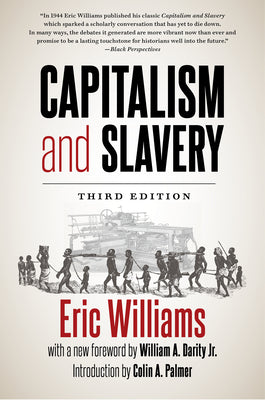
Slavery helped finance the Industrial Revolution in England. Plantation owners, shipbuilders, and merchants connected with the slave trade accumulated vast fortunes that established banks and heavy industry in Europe and expanded the reach of capitalism worldwide. Eric Williams advanced these powerful ideas in Capitalism and Slavery, published in 1944. Years ahead of its time, his profound critique became the foundation for studies of imperialism and economic development. Binding an economic view of history with strong moral argument, Williams's study of the role of slavery in financing the Industrial Revolution refuted traditional ideas of economic and moral progress and firmly established the centrality of the African slave trade in European economic development. He also showed that mature industrial capitalism in turn helped destroy the slave system. Establishing the exploitation of commercial capitalism and its link to racial attitudes, Williams employed a historicist vision that set the tone for future studies.
William A. Darity Jr.'s new foreword highlights Williams's insights for a new generation of readers, and Colin Palmer's introduction assesses the lasting impact of Williams's groundbreaking work and analyzes the heated scholarly debates it generated when it first appeared.
William A. Darity Jr.'s new foreword highlights Williams's insights for a new generation of readers, and Colin Palmer's introduction assesses the lasting impact of Williams's groundbreaking work and analyzes the heated scholarly debates it generated when it first appeared.
About the Author
About the Author
Eric Williams (1911-1981) served as the first prime minister of independent Trinidad and Tobago beginning in 1962 until his death. The author of many books, Williams was a professor of social and political science at Howard University prior to entering politics.
Critical Reviews
Critical Reviews
[This] new edition of Capitalism and Slavery, published by the University of North Carolina Press with a foreword by the economist William Darity, reminds us in particular of Williams's independent political and intellectual spirit and how his scholarship upended the historiographical consensus on slavery and abolition.--The Nation
Published in America in 1944, Capitalism and Slavery ignited a long-running academic controversy. A new edition this year -- a small miracle for a work of strict economic history almost eighty years old -- asks us to consider the legacy of a book that virtually invented the modern study of abolitionism.--Jacobin
Publishing Information
Publishing Information
Publisher:
University of North Carolina Press
Pub date:
2021-04-01
Length:
272 pages

The Allstora Membership
Membership Perks:
- Save 30% on all online store purchases
- Exclusive access to author's content
- You pay less, but authors still earn double
Membership Terms:
First Month:
$0.00
Monthly price:
$5.00
- To access membership discount simply log in and add to cart, discount applied automatically.
- One month free trial, cancel anytime. Membership renews on the 15th of each month.