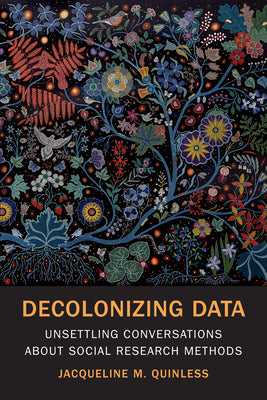
Decolonizing Data: Unsettling Conversations about Social Research Methods


Decolonizing Data: Unsettling Conversations about Social Research Methods
Decolonizing Data: Unsettling Conversations about Social Research Methods
Member Benefits
 30% Off All Books - Savings that support storytellers, not stock prices.
 Fight Book Bans - Every membership sends a book to LGBTQ+ youth in affected states.


Couldn't load pickup availability
Description
Description
Decolonizing Data explores how ongoing structures of colonialization negatively impact the well-being of Indigenous peoples and communities across Canada, resulting in persistent health inequalities. In addressing the social dimensions of health, particularly as they affect Indigenous peoples and BIPOC communities, Decolonizing Data asks, Should these groups be given priority for future health policy considerations?
Decolonizing Data provides a deeper understanding of the social dimensions of health as applied to Indigenous peoples, who have been historically underfunded in and excluded from health services, programs, and quality of care; this inequality has most recently been seen during the COVID-19 pandemic.
Drawing on both western and Indigenous methodologies, this unique scholarly contribution takes both a sociological perspective and the "two-eyed seeing" approach to research methods. By looking at the ways that everyday research practices contribute to the colonization of health outcomes for Indigenous peoples, Decolonizing Data exposes the social dimensions of healthcare and offers a careful and respectful reflection on how to "unsettle conversations" about applied social research initiatives for our most vulnerable groups.
Critical Reviews
Critical Reviews
" Decolonizing Data is a valuable resource and guide to taking a decolonized critical approach to Indigenous research for practitioners, academics, and researchers.. The book notably takes an important stance in discussing and executing allyship in Indigenous research in an important area of health and wellness. Jacqueline M. Quinless offers a unique case study that is very helpful for non-Indigenous researchers who are wanting to engage with Indigenous research in a respectful way."
--Lisa Monchalin, Professor of Criminology, Kwantlen Polytechnic University" Decolonizing Data is clear and concise. The literature is sound and conducted in a professional manner. This book will be useful in courses on decolonizing approaches, Indigenous methodologies, methods, health and well-being, social sciences, and research practices."
--Michael Lickers, Associate Faculty and Indigenous Scholar in Residence, School of Leadership Studies, Royal Roads University"We use Decolonizing Data in our Simon Fraser University Beedie School of Business Indigenous Business Leadership Executive MBA Course on Data and Decision-Making for Indigenous Businesses. A central part of our course is data ethical frameworks and data sovereignty, and Dr. Quinless's book presents the impacts of colonization not only on Indigenous health and well-being but also as a pathway for self-determination through data. The chapters in this book are laid out succinctly and provide a foundation for excellent discussions with our class on using data for decision-making."
--Kim van der Woerd, Lead for Strategy and Relations, Reciprocal Consulting Inc., Instructor at Simon Fraser University's Beedie School of Business and Continuing Education" Decolonizing Data is a powerful and thought-provoking book that challenges our understanding of data, the ways in which data has historically been used as a tool of oppression, and how it can be reimagined to serve the needs of Indigenous peoples and those who continue to be impacted by colonialism. This important and timely resource is not only important within the context of Canada, but also has international relevance. The legacy of colonialism has had profound impact on research processes around the world, and the need to decolonize data is a global issue. Through this work, Jacqueline Quinless provides a framework for addressing systemic inequities; it is a must read for anyone interested in understanding the intersection of data, power, and social justice."
--Crystal Tremblay, Assistant Professor & Co-Chair Map Shop, Department of Geography, University of Victoria, and Director, CIFAL Victoria"How can we start to rectify the many colonial systems that are measuring Indigenous 'sickness'? When I asked this question, Quinless took it seriously and in the book critically examines the role of data within the colonial systems. This book will be of benefit to allies wanting to do research work in better ways."
--Shannon Waters, Stz'uminus First Nation, Clinical Assistant Professor, School of Population and Public Health, University of British Columbia
Publishing Information
Publishing Information
The Allstora Membership
Membership Perks:
- Save 30% on all online store purchases
- Exclusive access to author's content
- You pay less, but authors still earn double
Membership Terms:
- To access membership discount simply log in and add to cart, discount applied automatically.
- One month free trial, cancel anytime. Membership renews on the 15th of each month.