Essentials of STEM Librarianship


Essentials of STEM Librarianship
Essentials of STEM Librarianship
Member Benefits
 30% Off All Books - Savings that support storytellers, not stock prices.
 Fight Book Bans - Every membership sends a book to LGBTQ+ youth in affected states.


Couldn't load pickup availability
Description
Description
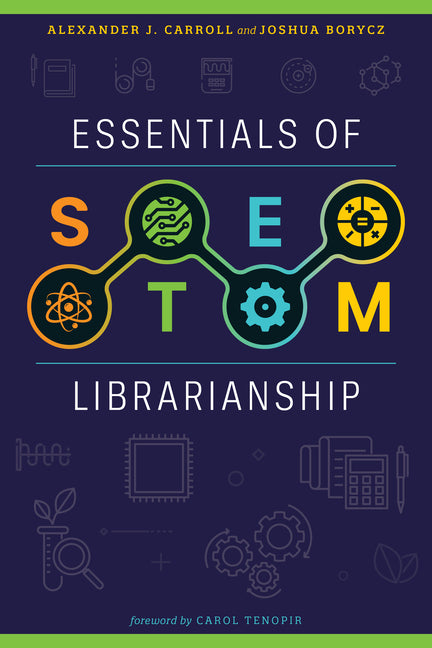
Amid overall falling enrollment figures for higher education, the growing success of STEM programs bucks the trend. Ensuring that these programs flourish has become a priority for administrators at the provost level and above. But this emphasis on STEM poses challenges for academic libraries, many of which have instead historically focused on the humanities and social sciences. This primer helps to fill that knowledge gap, demystifying the scientific teaching and research processes for LIS students and current academic librarians alike. Regardless of their background or level of experience, readers of this guide will
- gain an overview of the contemporary STEM teaching and research enterprise by learning about the roles and needs of STEM community members such as program administrators, tenure track principal investigators (PIs), non-tenure track teaching faculty, research staff, graduate students, and undergraduate students;
- become familiarized with the "research group," the organizational structure through which these different personas come together to advance the university research enterprise;
- get pointers on building teaching and learning programs that enhance student success and designing research support services that integrate into STEM researchers' actual workflows;
- receive proven outreach strategies for engaging STEM communities;
- learn approaches for incorporating AI (artificial intelligence) and LLMs (large language models) into information literacy programs for scientists and engineers; and
- discover how library leaders can support both nascent and established STEM librarians to advance STEM education and research at their local institutions.
About the Author
About the Author
Critical Reviews
Critical Reviews
"Organized in a clear three-part structure, this book is an excellent starting point for anyone interested in or beginning a career as a science librarian at a large, STEM-research-heavy academic institution that employs many science subject liaisons, such as those with a R1 Carnegie Classification ... The entire book does an excellent job acknowledging that higher education is changing and addressing how liaison librarian interactions with their departments likewise need to adapt. The authors provide suggestions and ideas based on their own experiences and what has worked for them. Many science librarians will appreciate the clear writing and helpful tables, as well as the summaries at the end of each chapter."
-- College & Research Libraries
"A masterful work that clearly outlines the essentials of STEM librarianship ... Chapter 9 gives an excellent introduction to Generative AI. The authors draw an apt comparison between 'traditional computing' and GAI as being similar to the difference between a musician who plays the musical score and a jazz musician, which helps explain why GAI is prone to producing hallucinations as a consequence of its probabilistic design. They conclude with thoughtful discussions on GAI's limitations and its connections with information literacy."
-- Dana L. Roth, Special Projects Librarian, California Institute of Technology (Caltech)
Publishing Information
Publishing Information

The Allstora Membership
Membership Perks:
- Save 30% on all online store purchases
- Exclusive access to author's content
- You pay less, but authors still earn double
Membership Terms:
- To access membership discount simply log in and add to cart, discount applied automatically.
- One month free trial, cancel anytime. Membership renews on the 15th of each month.