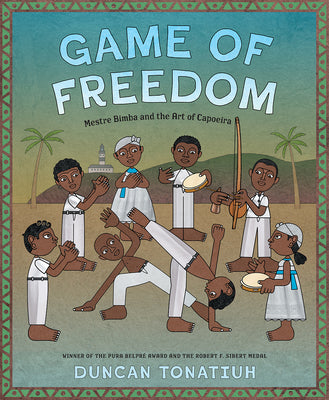
Game of Freedom: Mestre Bimba and the Art of Capoeira


Game of Freedom: Mestre Bimba and the Art of Capoeira
Game of Freedom: Mestre Bimba and the Art of Capoeira
Member Benefits
 30% Off All Books - Savings that support storytellers, not stock prices.
 Fight Book Bans - Every membership sends a book to LGBTQ+ youth in affected states.


Member Book Price
$19.99
$13.99
Couldn't load pickup availability
Description
Description
In the powerful, vibrant biography Game of Freedom, award-winning creator Duncan Tonatiuh sheds light on the legacy of a legendary capoeira player, Mestre Bimba, who resisted racial oppression through art and turned a marginalized practice into a global phenomenon. A meia lua whooshed in the air. The strike was evaded and followed with an aú.
Two young men were playing capoeira in the middle of the roda. Bimba wanted to play too. Although it is debated when and where capoeira--an art form that blends martial arts, dance, acrobatics, music, and spirituality--originated exactly, one thing is certain: in the early 20th century, Brazil was the only country in the world where capoeira was played, and it was mainly practiced by people of African descent. In 1890, two years after Brazil officially abolished slavery, the game was outlawed. Wealthy, lighter-skinned society feared and looked down on capoeira, seeing it as a game for malandros--what people in power called the poor Black communities they disdained. But in the early 1920s in the city of Salvador, a man called Bimba advocated for capoeira, and those who practiced it, demanding they be treated with dignity and respect. Duncan Tonatiuh's lyrical prose and beloved full-color illustrations, inspired by pre-Columbian codices, tell the story of arguably the greatest capoeirista of all time, who fought to turn a misunderstood, persecuted Afro-Brazilian activity into a celebrated art practiced by millions around the world. In 2014, the United Nations Educational, Scientific and Cultural Organization (UNESCO) named capoeira an Intangible Cultural Heritage of Humanity, a distinction awarded because of the game's promotion of social integration and the memory it holds of the struggle against historical oppression. From an award-winning author-illustrator, Game of Freedom is a stirring celebration of solidarity and resistance through art.
Two young men were playing capoeira in the middle of the roda. Bimba wanted to play too. Although it is debated when and where capoeira--an art form that blends martial arts, dance, acrobatics, music, and spirituality--originated exactly, one thing is certain: in the early 20th century, Brazil was the only country in the world where capoeira was played, and it was mainly practiced by people of African descent. In 1890, two years after Brazil officially abolished slavery, the game was outlawed. Wealthy, lighter-skinned society feared and looked down on capoeira, seeing it as a game for malandros--what people in power called the poor Black communities they disdained. But in the early 1920s in the city of Salvador, a man called Bimba advocated for capoeira, and those who practiced it, demanding they be treated with dignity and respect. Duncan Tonatiuh's lyrical prose and beloved full-color illustrations, inspired by pre-Columbian codices, tell the story of arguably the greatest capoeirista of all time, who fought to turn a misunderstood, persecuted Afro-Brazilian activity into a celebrated art practiced by millions around the world. In 2014, the United Nations Educational, Scientific and Cultural Organization (UNESCO) named capoeira an Intangible Cultural Heritage of Humanity, a distinction awarded because of the game's promotion of social integration and the memory it holds of the struggle against historical oppression. From an award-winning author-illustrator, Game of Freedom is a stirring celebration of solidarity and resistance through art.
About the Author
About the Author
Duncan Tonatiuh (toh-nah-tee-YOU) es un autor-ilustrador premiado. Él es mexicano y americano. Él creció en San Miguel de Allende, México, y se graduó de Parsons School of Design y Eugene Lang College en Nueva York. Su obra está inspirada en el arte precolombino. Su meta es crear imágenes y cuentos que honrar al pasado, pero que también son relevantes a la gente hoy, especialmente los niños. Él vive actualmente en San Miguel con su familia, pero viaja a menudo a los Estados Unidos.
Critical Reviews
Critical Reviews
***STARRED REVIEW***
"A great introduction to Capoeira and the persistence of Bimba to move this street performance into the mainstream. This masterpiece of illustration and narrative will appeal to readers across categories of martial arts, dance, and more."-- "School Library Journal" ****STARRED REVIEW****
"The author/illustrator's trademark pre-Colombian-flavored artwork lends itself wonderfully to the subject matter, with exaggerated poses and razor-sharp linework conveying body movements. A superb portrait of Afro-Brazilian endurance."-- "Kirkus"
"A great introduction to Capoeira and the persistence of Bimba to move this street performance into the mainstream. This masterpiece of illustration and narrative will appeal to readers across categories of martial arts, dance, and more."-- "School Library Journal" ****STARRED REVIEW****
"The author/illustrator's trademark pre-Colombian-flavored artwork lends itself wonderfully to the subject matter, with exaggerated poses and razor-sharp linework conveying body movements. A superb portrait of Afro-Brazilian endurance."-- "Kirkus"
Publishing Information
Publishing Information
Publisher:
Harry N. Abrams
Pub date:
2023-10-24
Length:
48 pages

The Allstora Membership
Membership Perks:
- Save 30% on all online store purchases
- Exclusive access to author's content
- You pay less, but authors still earn double
Membership Terms:
First Month:
$0.00
Monthly price:
$5.00
- To access membership discount simply log in and add to cart, discount applied automatically.
- One month free trial, cancel anytime. Membership renews on the 15th of each month.