Language Animal: The Full Shape of the Human Linguistic Capacity


Language Animal: The Full Shape of the Human Linguistic Capacity
Language Animal: The Full Shape of the Human Linguistic Capacity
Member Benefits
 30% Off All Books - Savings that support storytellers, not stock prices.
 Fight Book Bans - Book profits fund the Rainbow Book Bus, getting banned books to LGBTQ+ youth.


Member Book Price
$27.95
$19.57
Couldn't load pickup availability
Description
Description
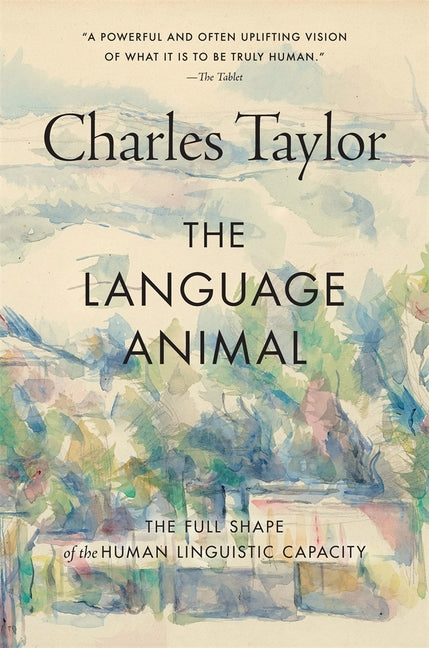
"We have been given a powerful and often uplifting vision of what it is to be truly human." --John Cottingham, The Tablet
In seminal works ranging from Sources of the Self to A Secular Age, Charles Taylor has shown how we create possible ways of being, individually and as a society. The Language Animal examines the foundation of this generative process. For centuries, philosophers have been divided on the nature of language. Rational empiricists--Hobbes, Locke, Condillac, and their heirs--assert that language is a tool to encode and communicate information. Yet this view neglects language's crucial role in shaping the thought it expresses. Taylor argues that language does not merely describe; it constitutes meaning. Nor is linguistic capacity innately possessed. We learn language from others, and our individual selves emerge from the conversation. Taylor expands the thinking of the German Romantics Hamann, Herder, and Humboldt into a theory of linguistic holism. Language is intellectual, but it is also enacted in artistic portrayals, gestures, metaphors, tones of voice, and the shifts of emphasis and attitude that accompany speech. Language recognizes no boundary between mind and body. In illuminating the full capacity of the language animal, Taylor sheds light on the very question of what it is to be human.
Critical Reviews
Critical Reviews
Characteristically, [Taylor's] latest book transgresses the boundaries of usually distinct philosophical topics, incorporating disciplines outside philosophy: anthropology, sociology and developmental psychology. Philosophy of language becomes the doorway to metaphysics, politics and ethics, and to working out the nature of modernity and what it has made us.--Jane O'Grady "Times Higher Education" (4/14/2016 12:00:00 AM)
Taylor moves well beyond theory, looking at the 'shape, scope and uses of language.' We find out a great deal about how language is learned, semantic invention, and how words fit into the broader palette of art, ritual, gesture and symbol.--Jonathan Wright "Catholic Herald" (4/22/2016 12:00:00 AM)
Taylor's argument is salutary and powerful. His erudition is impressive, and the rich diet of examples he assembles poses a serious challenge to facile reductionist accounts of language and of human nature.--Edward Feser "National Review" (5/23/2016 12:00:00 AM)
Taylor's prolific philosophical output is justly celebrated for the rich historical sweep of its learning...The Language Animal...is no exception...By the end we have been given a powerful and often uplifting vision of what it is to be truly human.--John Cottingham "The Tablet" (4/9/2016 12:00:00 AM)
True to its author's background in philosophy and political thought, The Language Animal is less a scientific, by-the-facts book than a reflective and often poetic account of how language shapes human experience.--Charisma Lee "LSE Review of Books" (4/30/2016 12:00:00 AM)
[Taylor's] ultimate objective in his latest book, The Language Animal, is to demonstrate how we can all live in a more tolerant 'flexible' (his word) world--if we can learn how to make the most of the resources, above all the resources for communication, we all share. This is a continuation of the ideas he has been working on throughout his astonishingly long and productive career. Taylor writes in a compelling, congenial way that enables him to encompass seeming contradictions.--Anthony Pagden "World Post" (11/3/2016 12:00:00 AM)
There is no other book that has presented a critique of conventional philosophy of language in these terms and constructed an alternative to it in anything like this way.--Akeel Bilgrami, Columbia University
Taylor is one of the handful of most important thinkers of our era. The line of thinking he develops in The Language Animal is basic to his whole work since Explanation of Behaviour. Many readers will grasp the importance of a constitutive view of language, and for them this will be a landmark book.--Craig Calhoun, Director of the London School of Economics and Political Science
Just as Humboldt believed that 'possessing a language is to be continuously involved in trying to extend its powers of articulation, ' Charles Taylor's new book, The Language Animal, demonstrates how the very study of language over time embodies the evolving human effort to extend our understanding--not only of language, but of the very self language helps to describe, propel, and transcend. It is a deeply thoughtful, historically enriching, and ultimately luminous book.--Maryanne Wolf, Tufts University
Publishing Information
Publishing Information
Publisher:
Belknap Press
Pub date:
2026-03-10
Length:
368 pages

The Allstora Membership
Membership Perks:
- Save 30% on all online store purchases
- Exclusive access to author's content
- You pay less, but authors still earn double
Membership Terms:
First Month:
$0.00
Monthly price:
$5.00
- To access membership discount simply log in and add to cart, discount applied automatically.
- One month free trial, cancel anytime. Membership renews on the 15th of each month.