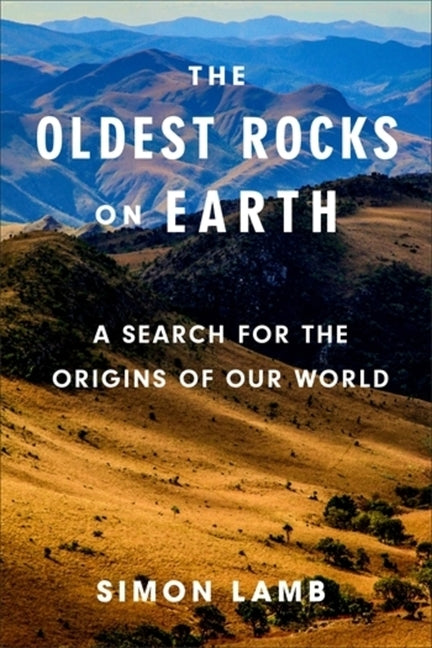
Oldest Rocks on Earth: A Search for the Origins of Our World


Oldest Rocks on Earth: A Search for the Origins of Our World
Oldest Rocks on Earth: A Search for the Origins of Our World
Member Benefits
 30% Off All Books - Savings that support storytellers, not stock prices.
 Fight Book Bans - Every membership sends a book to LGBTQ+ youth in affected states.


Member Book Price
$200.00
$140.00
Couldn't load pickup availability
Description
Description
Earth has existed for an immense period of time--an almost unimaginable 4.6 billion years. If we ventured far enough into the past, would we reach a time when our planet was fundamentally different? Did it always have landscapes like those we see today, sculpted by wind, rain, and the forces of plate tectonics? When did Earth turn into the distinctive "blue planet" where life could emerge and evolve?
Geologist Simon Lamb shows that the key to answering these questions lies in ancient rocks from the days when the planet was young. His research in remote southern Africa looks at some of the oldest known rocks--some more than 3.5 billion years old--which have survived unfathomable spans of geological time. He takes readers on a journey of scientific discovery, walking--and sometimes diving--through landscapes from the time of the earliest documented forms of life. Lamb unearths a violent world of volcanic eruptions, natural disasters, and profound geological forces in the deep ocean, along ancient shorelines, and amid rising mountains. In so doing, he shows how geologists work and think, and how they read rocks and decipher what they tell us about the past. Finding the foundations of our world, The Oldest Rocks on Earth sheds light on why Earth is the only planet known to harbor life and what this might tell us about our future.
About the Author
About the Author
Simon Lamb is adjunct professor of geophysics at Victoria University of Wellington in New Zealand. He is the author of Devil in the Mountain: A Search for the Origin of the Andes (2004) and coauthor of Earth Story: The Forces That Have Shaped Our Planet (1998). Lamb has been a consultant, producer, or director of a number of BBC science documentaries.
Critical Reviews
Critical Reviews
An interesting and entertaining read. Paleontologists will easily relate to the trials and tribulations of the geological field work that Lamb describes.-- "Trilobite Tales"
An entertaining and instructional overview of geology and paleontology with a specific focus on the origin of planet Earth and the first steps in Earth's history. The Oldest Rocks on Earth provides a glimpse into how scientists work to unravel geologic history.--Nora Noffke, Old Dominion University
In this brilliant narrative, Lamb intertwines deep thinking about geology with his own experiences as a young graduate student working in remote Africa. He breathes new life into earth sciences throughout the book, connecting the mysteries of early Earth with present-day issues of climate change and human evolution.--Tim Stern, fellow of the American Geophysical Union
An enthusiastic account of Earth's 4-billion-year history... ['The Oldest Rocks on Earth' is] a solid read about geological masses that have survived 'mind-boggling spans of geological time.'-- "Kirkus"
Publishing Information
Publishing Information
Publisher:
Columbia University Press
Pub date:
2026-01-06
Length:
352 pages


The Allstora Membership
Membership Perks:
- Save 30% on all online store purchases
- Exclusive access to author's content
- You pay less, but authors still earn double
Membership Terms:
First Month:
$0.00
Monthly price:
$5.00
- To access membership discount simply log in and add to cart, discount applied automatically.
- One month free trial, cancel anytime. Membership renews on the 15th of each month.