Pollen: Darwin's 130 Year Prediction


Pollen: Darwin's 130 Year Prediction
Pollen: Darwin's 130 Year Prediction
Member Benefits
 30% Off All Books - Savings that support storytellers, not stock prices.
 Fight Book Bans - Every membership sends a book to LGBTQ+ youth in affected states.


Couldn't load pickup availability
Description
Description
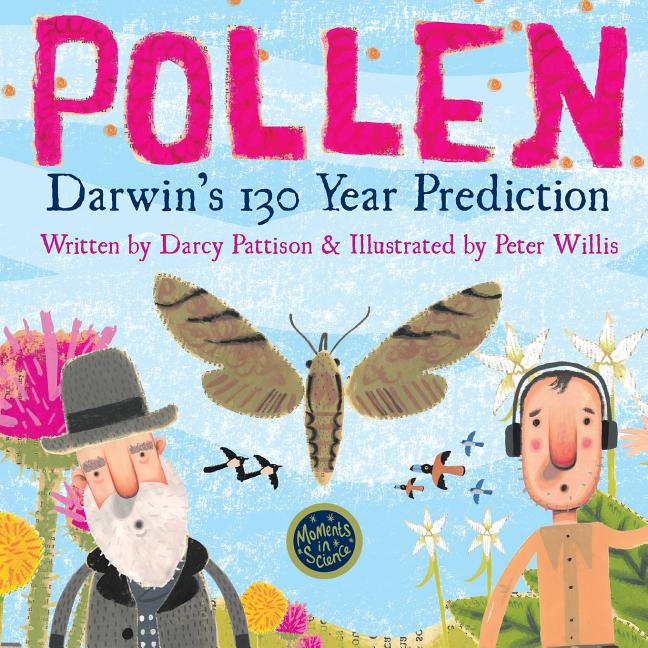
POLLEN: DARWIN'S 130 YEAR PREDICTION
Elementary Science - POLLEN
How long does it take for science to find an answer to a problem?
On January 25, 1862, naturalist Charles Darwin received a box of orchids. One flower, the Madagascar star orchid, fascinated him. It had an 11.5" nectary, the place where flowers make nectar, the sweet liquid that insects and birds eat. How, he wondered, did insects pollinate the orchid? It took 130 years to find the answer.
After experiments, he made a prediction. There must be a giant moth with a 11.5" proboscis, a straw-like tongue. Darwin died without ever seeing the moth, which was catalogued by entomologists in in 1903. But still no one had actually observed the moth pollinating the orchid.
In 1992, German entomologist, Lutz Thilo Wasserthal, Ph.D. traveled to Madagascar. By then, the moths were rare. He managed to capture two moths and released them in a cage with the orchid. He captured the first photo of the moth pollinating the flower, as Darwin had predicted 130 years before.
Backmatter includes information on the moth, the orchid, Charles Darwin, Lutz Wasserthal. Also included is Wasserthal's original photo taken in 1992.
MOMENTS IN SCIENCE COLLECTION
This exciting series focuses on small moments in science that made a difference.
- BURN: Michael Faraday's Candle
- CLANG! Ernst Chladni's Sound Experiments (2019 NSTA Outstanding Science Trade Book)
- ECLIPSE: How the 1919 Eclipse Proved Einstein's Theory of General Relativity (Fall, 2019)
Critical Reviews
Critical Reviews
"POLLEN is extraordinary! What a great story that encapsulates so many important concepts in science - pollination, structure and function of living things, and how scientific discoveries take time. It is so well written and will make a wonderful read-aloud." Emily Morgan, co-author of Picture Perfect Science
Publishing Information
Publishing Information

The Allstora Membership
Membership Perks:
- Save 30% on all online store purchases
- Exclusive access to author's content
- You pay less, but authors still earn double
Membership Terms:
- To access membership discount simply log in and add to cart, discount applied automatically.
- One month free trial, cancel anytime. Membership renews on the 15th of each month.