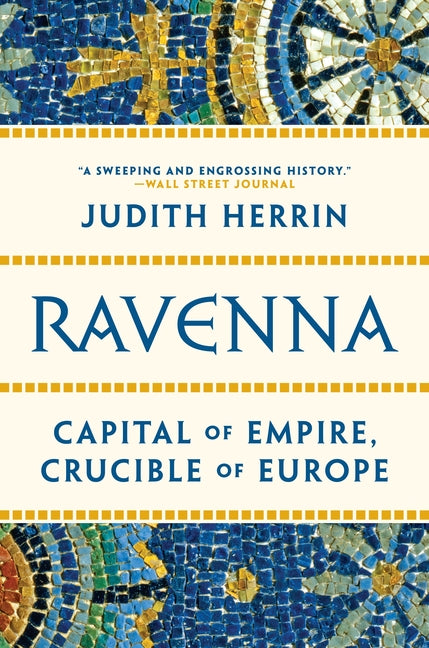
Ravenna: Capital of Empire, Crucible of Europe


Ravenna: Capital of Empire, Crucible of Europe
Ravenna: Capital of Empire, Crucible of Europe
Member Benefits
 30% Off All Books - Savings that support storytellers, not stock prices.
 Fight Book Bans - Every membership sends a book to LGBTQ+ youth in affected states.


Member Book Price
$49.92
$34.94
Couldn't load pickup availability
Description
Description
'Magisterial - an outstanding book that shines a bright light one of the most important, interesting and under-studied cities in European history. A masterpiece.' Peter Frankopan
'A wonderful new history of the Mediterranean from the fifth to eighth centuries through a lens focussed on Ravenna, gracefully and clearly written, which reconceptualises what was 'East' and what was 'West'.' Caroline Goodson 'A masterwork by one of our greatest historians of Byzantium and early Christianity. Judith Herrin tells a story that is at once gripping and authoritative and full of wonderful detail about every element in the life of Ravenna. Impossible to put down.' David Freedberg In 402 AD, after invading tribes broke through the Alpine frontiers of Italy and threatened the imperial government in Milan, the young Emperor Honorius made the momentous decision to move his capital to a small, easy defendable city in the Po estuary - Ravenna. From then until 751 AD, Ravenna was first the capital of the Western Roman Empire, then that of the immense kingdom of Theoderic the Goth and finally the centre of Byzantine power in Italy. In this engrossing account Judith Herrin explains how scholars, lawyers, doctors, craftsmen, cosmologists and religious luminaries were drawn to Ravenna where they created a cultural and political capital that dominated northern Italy and the Adriatic. As she traces the lives of Ravenna's rulers, chroniclers and inhabitants, Herrin shows how the city became the pivot between East and West; and the meeting place of Greek, Latin, Christian and barbarian cultures. The book offers a fresh account of the waning of Rome, the Gothic and Lombard invasions, the rise of Islam and the devastating divisions within Christianity. It argues that the fifth to eighth centuries should not be perceived as a time of decline from antiquity but rather, thanks to Byzantium, as one of great creativity - the period of 'Early Christendom'. These were the formative centuries of Europe. While Ravenna's palaces have crumbled, its churches have survived. In them, Catholic Romans and Arian Goths competed to produce an unrivalled concentration of spectacular mosaics, many of which still astonish visitors today. Beautifully illustrated with specially commissioned photographs, and drawing on the latest archaeological and documentary discoveries, Ravenna: Capital of Empire, Crucible of Europe brings the early Middle Ages to life through the history of this dazzling city.
About the Author
About the Author
Judith Herrin is professor emeritus in the Department of Classics at King's College London. Her books include Byzantium: The Surprising Life of a Medieval Empire; Unrivalled Influence: Women and Empire in Byzantium; Margins and Metropolis: Authority across the Byzantine Empire; Women in Purple: Rulers of Medieval Byzantium; and The Formation of Christendom (all Princeton). She lives in Oxford, England.
Critical Reviews
Critical Reviews
"Winner of the Pol Roger Duff Cooper Prize"
"Winner of the PROSE Award in European History, Association of American Publishers"
"Shortlisted for the Wolfson History Prize, Wolfson Foundation"
"Shortlisted for the London Hellenic Prize, The Hellenic Centre"
"Longlisted for the Cundill History Prize, McGill University"
"Judith Herrin explains in her lively, startling book, Ravenna really did deserve 'the most noble' title bestowed by this anonymous admirer. From its origins as a refuge in a dying empire, it went on to host kings and prelates, physicians and lawyers--and ultimately help shape Europe."-- "The Economist"
"The book is absolutely gorgeous, with magnificent colour reproductions of Ravenna's churches and mosaics. Relics of an age that seems almost impossibly remote, they are the foundations on which modern Europe stands."---Dominic Sandbrook, Sunday Times
"[E]minently worth reading. The colour plates are so sumptuous that the Ravenna mosaics fairly glow on the page. History teaches us that it is on the margins that the greatest change often occurs. Ravenna was on such a margin. Now, perhaps for the first time, the city emerges triumphant from the shadow of the so-called Dark Ages."---Ian Thomson, The Spectator
"Aficionados of early medieval history--and of course Ravenna itself--will learn much from Herrin's work."-- "Kirkus Reviews"
"Beautifully illustrated, impeccably researched and accessibly presented, it traces Ravenna's career as the capital of the Roman empire in the west. . . . Buildings are also brought to life alongside the people who built and used them. . . . It is this linking of tangible remains and historical record that is the book's great strength."---Jonathan Harris, BBC History Magazine
"Herrin tells the changing story of Ravenna as it unfolds from the end of the fourth century to the ninth in a series of short, accessible sections with the aid of luscious illustrations."---Averil Cameron, History Today
"Judith Herrin's book [Ravenna] explains by recounting the city's life from 402, when it became the capital of the Roman Empire in the West, to 751, when the Lombards took over. The story is not, she emphasises, one of decline, but of rebirth, for Ravenna established what European Christendom could become. . . . By the time we can easily visit Ravenna the city again it should be with the advantage of having read Ravenna the book."---Christopher Howse, The Telegraph
"[Ravenna] is absolutely gorgeous, with magnificent colour reproductions of Ravenna's churches and mosaics. Relics of an age that seems almost impossibly remote, they are the foundations on which modern Europe stands."---Dominic Sandbrook, The Times
"Bold. . . . elegantly argue[d]."-- "New Yorker"
"
Magnificent. . . recaptures the excitement of discovering the history of a city where East Rome and Latin Europe joined for many centuries in ways that defy our neat divisions between ancient and medieval; Romans, Greeks, and barbarians; East and West.
"---Peter Brown, New York Review of Books "A sweeping and engrossing history . . . an accessible narrative that brings to life the men and women who created the city during this period and who fashioned its hybrid Christian culture of Latin, Greek and Gothic elements. The narrative is periodically elevated by discussions of the city's most famous attractions and its glorious churches, brilliantly illustrated in the book's 62 color plates. It is also enlivened by recurring digressions on daily life in the city at each phase in its history."---Anthony Kaldellis, Wall Street Journal "[T]ake [Judith] Herrin's book slowly. It's not a skimmer. There's a lot to absorb. A careful, patient read best reveals the book's richness."---Brian T. Allen, National Review "Judith Herrin's Ravenna sparkles like the city's world-heritage mosaics . . . [this] sweeping social and cultural history is presented in easily digestible sections and augmented with lavish illustrations."---Michael Champion, Australian Book Review "A masterwork of scholarship and sharp intelligence."---Neal Ascherson, Red Pepper "Herrin's study and its admirable illustrations are well worth readers' attention . . . . An informative and enjoyable book."---Catharine S. Brosman, Chronicles Magazine "Judith Herrin tells its fascinating history and presents a parade of forceful and creative characters with great insight and a wonderfully light touch, in a book as beautifully produced as it is profoundly researched."---R.I. Moore, author of The War on Heresy
Publishing Information
Publishing Information
Publisher:
Princeton University Press
Pub date:
2020-10-27
Length:
576 pages

The Allstora Membership
Membership Perks:
- Save 30% on all online store purchases
- Exclusive access to author's content
- You pay less, but authors still earn double
Membership Terms:
First Month:
$0.00
Monthly price:
$5.00
- To access membership discount simply log in and add to cart, discount applied automatically.
- One month free trial, cancel anytime. Membership renews on the 15th of each month.