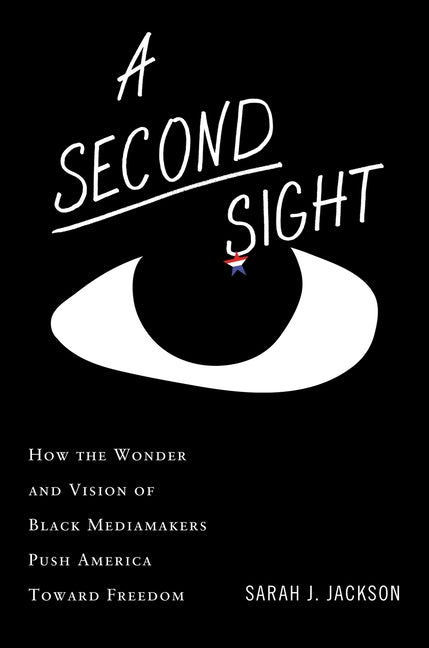
Second Sight: How the Wonder and Vision of Black Mediamakers Push America Toward Freedom


Second Sight: How the Wonder and Vision of Black Mediamakers Push America Toward Freedom
Second Sight: How the Wonder and Vision of Black Mediamakers Push America Toward Freedom
Member Benefits
 30% Off All Books - Savings that support storytellers, not stock prices.
 Fight Book Bans - Every membership sends a book to LGBTQ+ youth in affected states.


Couldn't load pickup availability
Description
Description
"I have been waiting for a book like this, and I'm so glad it's here." -- Clint Smith, author of How the Word is Passed
Since the nation's founding, Black Americans have had a unique perspective on the U.S. experience--a "second sight"--that reveals the truth about the nation to itself. As renowned media scholar Sarah J. Jackson charts in this bold and daring masterwork, at the center of this effort has been an extraordinary cast of Black journalists, photographers, filmmakers, radio hosts, podcasters and other mediamakers who have drawn on the visionary tradition of second sight to advance democracy and broaden our most fundamental American values.
When Black mediamakers raise their voices and speak uncomfortable truths about America, they shape memories of the nation and push us toward a future more closely aligned with our espoused values. For two centuries, this "second sight" has been an overlooked engine of American democracy.
Drawing from W.E.B. Du Bois's philosophical work, along with deep historical analysis and dozens of interviews with today's most active Black mediamakers, A Second Sight shows these visionaries positioned at the margins of their industries and navigating fraught relationships to power. They've warned of the greatest dangers to democracy--from slavery to Nazism, and mass incarceration to misinformation. Their work is central to our culture and politics. Yet it is devalued, met with violent censure, or achieved only via ingenious work-arounds. This tension has sharpened their commitments to truth.
Now one of our nation's foremost scholars of American media, Sarah J. Jackson, presents an appraisal that situates Black mediamakers at the vanguard of telling the American story. Brilliant, urgent and illuminating, A Second Sight is an authentic and candid grappling with a discordant thread in the American fabric and, in tracing a bolder vision for the nation, presents a way forward.
Critical Reviews
Critical Reviews
"We are living through a technological era in which the nation's media landscape is changing at an extraordinary rate. Amid the shift, one thing that has remained consistent is how Black journalists, filmmakers, writers, and artists have used their unique perspectives, stories, and histories to make sense of our evolving world at every turn. Sarah Jackson's A Second Sight is an invaluable examination of the role Black mediamakers have played in shaping how America understands itself. I have been waiting for a book like this, and I'm so glad it's here." - Clint Smith, author of How the Word is Passed: A Reckoning with the History of Slavery Across America
"Sarah Jackson has created a thorough and necessary survey of Black mediamakers, both past and current, and the landscape of challenges, possibilities and achievements that define their tradition. Intellectually nimble and deeply original, this book is equal to its worthy subject matter. At a time when antagonists are actively trying to silence insurgent Black voices Jackson's work turns up the volume. We would do well to listen." - Jelani Cobb, author of Three or More is a Riot: Notes on How We Got Here: 2012-2025
"Sarah Jackson's engaging analysis of more than a century of Black creative process and production is a beautifully drawn portrait of Black media and the courageous people who have made it. From the key figures in movements to abolish slavery and end lynching, to contemporary filmmakers and podcasters, who explore the persistent problem of anti-black violence and implore audiences to seek joy, Jackson has made a compelling and critical argument for how every generation has used their second sight not only to advance strategies for liberation, but also to demonstrate the power of the creative mind to respond to fear, grief, and hope. A must-read for anyone who wonders how we got here and what we need to do next." - Marcia Chatelain, Pulitzer-Prize winning author of Franchise: The Golden Arches in Black America
"Sarah J. Jackson's A Second Sight is the book we need right now for its incisive critique, narrative innovations, and illumination of spirit in these dark times. Jackson has produced a gorgeously written account of Black mediamakers who inspire us to, in her words, 'dream more expansively.' Indeed, in A Second Sight, Jackson reinvigorated my own hope for 'a world where everyone's lives are sacred.'" - Ralina L. Joseph, Vice Provost of Inclusive Excellence and Professor of African American Studies at UCLA
"A Second Sight is an ambitious, deeply researched, intellectually expansive work that is certain to become an interdisciplinary touchstone across a wide range of scholarly and pedagogical spaces -- from the undergraduate classroom to the libraries of the most seasoned scholars. However one arrives at this momentous study, readers will come away enlightened with an understanding of how Black mediamakers have shaped the nation's understanding of Blackness, be it through factual reporting or creative fiction. From the fearless reporting of Ida B. Wells and Nikole Hannah-Jones, to the stunning visual archives of James Van Der Zee and Gordan Parks, to the filmic storytelling of Ava DuVernay and Ryan Coogler, these cultural producers illuminate difficult and often contested truths, while compelling us to reckon with the ideas that shape the contours of our collective consciousness. With A Second Sight, Sarah Jackson has produced a triumphant, sophisticated, and enduring scholarly contribution." - Robin Means Coleman, Professor of Media Studies at the University of Virginia
"From the 18th-century poet Phyllis Wheatley to Alex Haley's 1970s book and miniseries Roots to Steve McQueen's 2013 film 12 Years a Slave, Jackson explores other bedrock freedoms cultivated by Black media-makers including freedom of association, freedom of the press, and freedom of expression. Jackson manages to keep things light-hearted with plenty of pop culture references and entertaining anecdotes, all couched in solid scholarship. It's a lively and edifying tour of Black historymaking." - Publishers Weekly
"A comprehensive survey of Black media, including print, photography, and film.... The author highlights the historic roles of Frederick Douglass and W. E. B. Du Bois. Jackson also recognizes notable exceptions, such as Gordon Parks's decadeslong work for Life magazine and the apologies issued by the Kansas City Star and the Los Angeles Times for past injustices.... This book reveals episodes in the history of Black media involving surprising, if not consistent suppression; reactions to Nikole Hannah-Jones's The 1619 Project might confirm Jackson's thesis. Recommended." - LIbrary Journal
"Jackson lays out a gripping tribute to the power of Black storytelling and the voices willing to show us what we, as a multiracial country, might otherwise choose not to see." - The Philadelphia Citizen
"In a time when the media is under increased scrutiny and distrust, Annenberg School associate professor Sarah J. Jackson has written this extraordinary exploration into the pivotal roles Black storytellers and mediamakers have played in shaping this country, its history and its democracy." - Ms. magazine
Publishing Information
Publishing Information

The Allstora Membership
Membership Perks:
- Save 30% on all online store purchases
- Exclusive access to author's content
- You pay less, but authors still earn double
Membership Terms:
- To access membership discount simply log in and add to cart, discount applied automatically.
- One month free trial, cancel anytime. Membership renews on the 15th of each month.