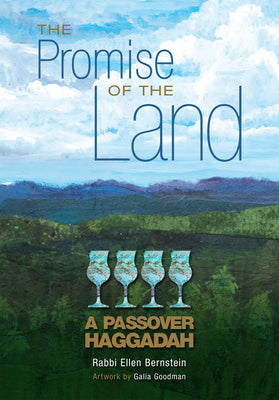
The Promise of the Land: A Passover Haggadah


The Promise of the Land: A Passover Haggadah
The Promise of the Land: A Passover Haggadah
Member Benefits
 30% Off All Books - Savings that support storytellers, not stock prices.
 Fight Book Bans - Every membership sends a book to LGBTQ+ youth in affected states.


Couldn't load pickup availability
Description
Description
From the unassuming matzah that reveals the simplicity of earth, wheat, and water, to the first fruits of the soil that the Israelites offered in gratitude, the earth has always been at the center of who we are as a people.
Passover marks the Jewish people's liberation from slavery in Egypt and the coming of spring. Yet it is also a story about land and the natural world. All our biblical holidays - Passover included - originally commemorated the agrarian and pastoral soil of of which Judaism grew. This haggadah keeps the earth at the forefront of our minds. In addition to all the traditional blessings and rituals, it includes sidebars and other features that uncover the connections between the seder and the land. For instance, karpas symbolizes the vibrant, verdant energy of spring, and reminds us that, like plants, we are born of the earth. Dayeinu is seen as a commentary on appreciating what we have and avoiding waste and overconsumption. Stunning artwork enhances the moods and themes of the seder in warm tones that are at once vibrant and earthy."A marvelous new contribution in an ecological vein . . . a haggadah in the spirit of Abraham Joshua Heschel" --Rabbi Jonathon Seidel, PhD, spiritual leader of Or haGan, Eugene Oregon
Critical Reviews
Critical Reviews
Not every Hag-gadah comes with an endorse-ment by the envi-ron-men-tal-ist
Bill McK-ibben, but this edi-tion cel-e-brates the nat-ur-al world and its sig-nif-i-cance in our lives as we come togeth-er to cel-e-brate Passover.It is intend-ed for both knowl-edge-able and unfa-mil-iar par-tic-i-pants. The tra-di-tion-al text, large-ly in Eng-lish, is print-ed in green; eco-log-i-cal com-men-tary, con-text, and side-bars, empha-siz-ing nature and the land, are print-ed in black and are intend-ed to encour-age dis-cus-sion. An inter-est-ing inclu-sion in this Hag-gadah are the last two vers-es of the Magid (Deuteron-o-my 26:9 - 10), omit-ted in the tra-di-tion-al text: "Adonai...gave us this land," a sig-nif-i-cant mes-sage for this eco-log-i-cal retelling. In a brief dis-cus-sion the author explores the rea-sons for the omis-sion and the impor-tance of their inclu-sion here. The illus-tra-tions by Galia Good-man enrich the texts. --Maron L. Waxman, The Jewish Book CouncilIn an era when a plethora of haggadot are being published for diverse audiences,
Rabbi Ellen Bernstein has given us a marvelous new contribution in an ecological vein. The Promise of the Land is a work of creative liturgy . . .The Promise of the Land is also a work of eco-philosophy. Bernstein's primary challenge in creating an ecologically oriented haggadah was to connect freedom--the central idea of the haggadah--to the earth.She has done this quite successfully. By reclaiming two
land-centered verses from the original instructions for Passover that had been abandoned for millennia, and reading them ecologically, Bernstein has sparked a radical way of considering the meaning of the Hebrew "aretz". In the introduction to her haggadah she discusses how aretz, which can mean both land and earth, must be understood as a living organism, not as flat, inert stuff, not as territory or real estate, nor as the land of Israel solely. To my mind, this is a simple but brilliant move. This bold step in re-translation and rethinking allows us to look at earth and land from the prism of balance, reciprocal relationships, and care. . .The Seder Bernstein envisions does not thrust us headfirst into the climate emergency. It is not a "Climate Emergency" or "Scorching
Earth" Seder. Rather it reminds us to free ourselves from the internal Pharaoh of overconsumption and once we have liberated ourselves from enslavement we can move into guardianship of the land, as imagined in Leopold's Sand County Almanac. Throughout the haggadah, Bernstein offers pungent and highly-selective texts that encourage us to care for creation.She
also offers poignant, deep ecological gems along the way.. . Another virtue of Bernstein's Promise is that it serves as a beautiful example of "Hiddur Mitzvah"--adorning a commandment. It is gorgeously illustrated by Galia Goodman whose work lifts up the haggadah by offering a visual midrash. Further enhancing its artistry, the haggadah is color-coded and user-friendly, not burdensome, with traditional text and new commentary that manages to be both brief and stimulating.Bernstein integrates
natural scientific explanations of miracles without subtracting from the mythopoetic impact of the story. Her work is midrashic in the best sense, of seeking to extract or should I say divine the meaning of the Seder for our times. It is a haggadah in the spirit of Abraham Joshua Heschel.The Promise of the Land is a Seder for all Jews and
friends and carries a critical and essential message for our time, echoing our Shmita-conscious ancestors: It is incumbent upon to work to fulfill the promise of the land, in loving cooperation with our Creator. It is perhaps the most potent and timely re-imagining of the Pesach message in the last few years. Here Rabbi Ellen Bernstein has made her mark.This literary
work of art joins that of scholars and artists who are producing excellent new liturgies and eco-philosophies throughout North America, Europe, and Israel. In The Promise of the Land, we have the perfect blueprint for a truly integrated, holistic, and practical Seder. --Rabbi Jonathon Seidel, PhD, spiritual leader of Or haGan, Eugene Oregon
Publishing Information
Publishing Information
The Allstora Membership
Membership Perks:
- Save 30% on all online store purchases
- Exclusive access to author's content
- You pay less, but authors still earn double
Membership Terms:
- To access membership discount simply log in and add to cart, discount applied automatically.
- One month free trial, cancel anytime. Membership renews on the 15th of each month.